Blog
What The ‘co.’ Stands For

- Essay
- JUNE 8, 2025
- IN MEMORY OF ANTHONY BOURDAIN · 1956–2018
What The ‘Co.’ Stands For
It isn’t Company. It’s Confidential.
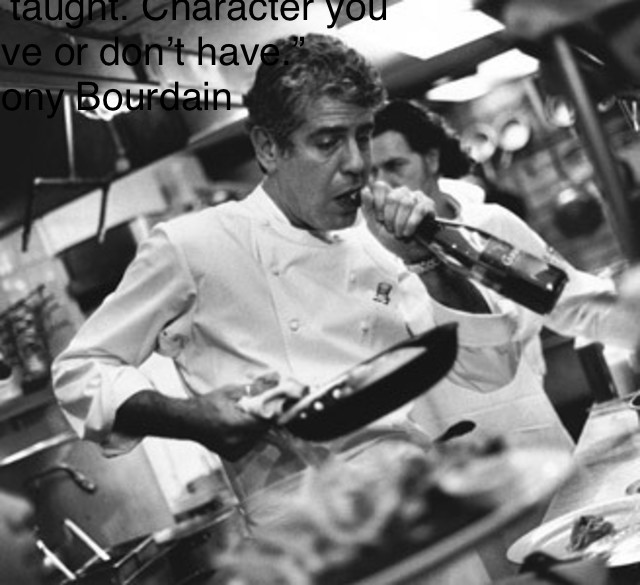
Anthony Bourdain at work in the kitchen.
BY MICHAEL PAGE
I met Anthony Bourdain once.
It was brief. It mattered.
I was working seasonally as the chef of a lakeside hotel in Greenwood Lake, New York, and we were closed for the winter season. My oldest son, Hudson, was barely walking when I learned that Tony would be signing copies of Appetites at a bookstore in Greenwich Village.
It was a cold New York day, but the signing was inside a bookstore with an ample children’s section. I couldn’t think of a good reason not to bring baby Hudson with me.
Before the signing, Tony held a short question-and-answer session. Then he sat down to sign what must have felt like a hundred books.
Eventually, it was my turn.
We spoke briefly while he signed my copy of Appetites. I told him that I had worked for his friends Eric and Bruce from Blue Ribbon while I was up in Vermont.
It was a small connection, but it gave me something real to share with him. The restaurant world can feel enormous from the outside and remarkably small once you have spent enough years working inside it.
There was no long conversation or profound exchange. A line of people was still waiting behind me, each carrying a book and hoping for a moment of their own.
I was simply a cook meeting the writer whose work had made so many people like me feel seen.
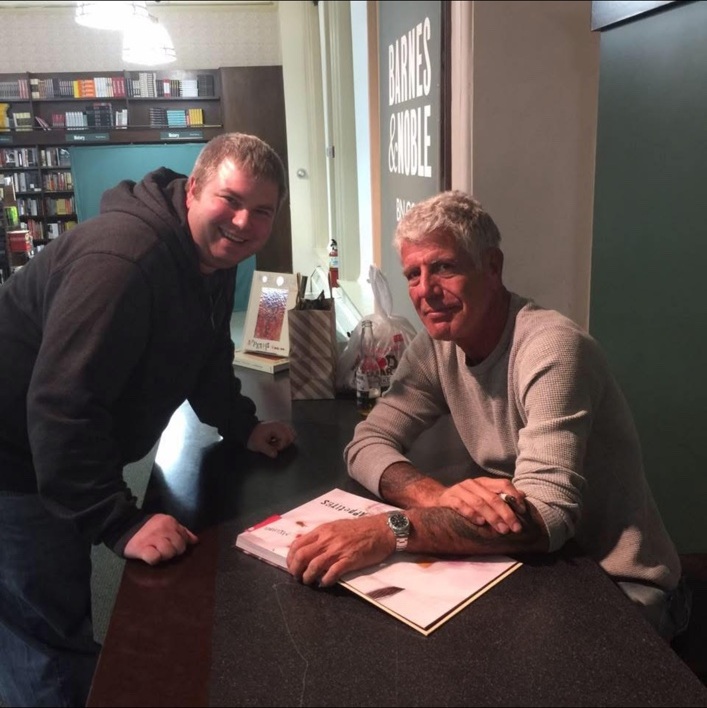
The photograph captures exactly how I felt.
I’m the grinning cook leaning across the table. Tony is sitting beside me, his hand resting near the book. Hudson was there with me, somewhere just outside the frame.
Tony didn’t know me. I’m not going to exaggerate a short meeting and pretend we shared some personal relationship. We didn’t.
But his work had already meant something to me.
Like countless cooks, I recognized the world he described in Kitchen Confidential: the pressure, exhaustion, humor, pride, dysfunction and strange sense of family that develops among people working behind the kitchen door.
He wrote about cooks as if our lives were worth writing about.
That may sound like a small thing.
It wasn’t.
Bourdain told the truth about kitchens without stripping away their romance. He respected the dishwasher, the line cook, the street vendor and the grandmother preparing the dish she had made for her family her entire life.
He could eat in one of the world’s great restaurants and then become equally excited about something served on a plastic stool beside a road.
The price of the meal didn’t determine its dignity.
Neither Tony nor I could have known how his visit to Charleston would later change my life for the better—and forever.
When I watched him experience Charleston, he made the city feel familiar before it was familiar to me. He didn’t present it as a postcard or a collection of tourist attractions. He found its food, its history, its contradictions and the people who gave the place its character.
He even celebrated the Waffle House.
That mattered to me.
He could appreciate the work of a celebrated chef and then sit beneath the fluorescent lights of a roadside diner with the same curiosity and enthusiasm. He understood that a place reveals itself through its everyday rituals just as honestly as it does through its finest dining rooms.
His Charleston felt lived in. It felt unpretentious. It felt like a place where serious food and ordinary food could both be worthy of respect.
More importantly, it felt like somewhere my family and I could belong.
Long before we moved south, Bourdain helped make Charleston feel like home.
I couldn’t have known how COVID would transform the restaurant business in New York or how completely the direction of my own life and career would change. I couldn’t have known that I would eventually settle near Charleston, raise my family here and build a restaurant whose name carried a quiet tribute to him.
There are things I wish I could go back and tell him.
I wish I could tell him that the city he once explored through food became the place my family calls home.
I wish I could explain how deeply his words about travel shaped me and the career I eventually built at sea.
Most of all, I wish I could tell him that watching his shows and reading his books often felt like spending time with a friend I hadn’t realized I possessed.
Tony did not know me.
But through his work, I felt as though I knew something of him.
That is an unusual relationship to have with a writer. It may also be the greatest gift a writer can give.
Bourdain traveled with curiosity rather than judgment.
He showed us that another culture wasn’t something to fear, conquer or reduce to a list of differences. Sometimes the first step toward understanding another person was simply sitting down, accepting the plate placed in front of you and listening.
That idea has stayed with me because travel has also shaped my life.
I have spent much of my career working as a merchant mariner. My experience of travel rarely resembles a vacation. I have crossed oceans aboard working ships, lived for months among people far from their families and stepped ashore in places where I was unmistakably the visitor.
Traveling as a mariner teaches you humility.
You arrive by sea, often tired, disoriented and dependent upon people who understand the language, customs and place better than you do. You learn quickly that your way of living is not the only way—and usually not the most interesting one.
Bourdain understood that travel should unsettle you a little. It should challenge your assumptions rather than simply confirm them. He didn’t visit another country to demonstrate how strange everyone else was. He allowed the experience to reveal how limited his own understanding had been.
Life aboard a ship teaches something similar.
People from different backgrounds work, eat and live beside one another in a confined space for months. Rank and responsibility may determine the job, but everyone eventually meets around the same table.
Food becomes comfort, routine, memory and one of the few ways to make a steel vessel feel temporarily like home.
Some of the most honest hospitality I have experienced was not expensive or elaborate. It was a plate offered by someone proud to share what they knew, in a place where I was the outsider.
That is one reason Bourdain’s work connected so deeply with me. He understood that the purpose of travel wasn’t merely to see the world.
It was to allow the world to change you.
Most people will assume the ‘Co.’ in Pine Barrens Pizza Co. stands for Company.
It doesn’t.
For us, it stands for Confidential.
It is a quiet tribute to the chef and writer who gave so many cooks a language for the lives we were already living.
It is also a reminder of the values we want Pine Barrens to carry forward: honesty, curiosity, respect for the people doing the work and the belief that good food does not require pretense.
Serious Pizza. No Pretense.
Bourdain’s appreciation of Waffle House demonstrated that ‘no pretense’ doesn’t mean an absence of standards.
It means judging food by the honesty and satisfaction of the experience—not by the price, reputation or formality surrounding it.
That is what we want Pine Barrens to represent.
We named one of our focaccia sandwiches The Bourdain.
The name isn’t meant to borrow celebrity or suggest that he endorsed the sandwich. It is our way of acknowledging the person whose work helped shape how we think about cooks, travel, hospitality and the importance of sharing a meal.
But after his death, a tribute bearing his name could not feel complete if it only sold sandwiches.
For every Bourdain sandwich sold, Pine Barrens Pizza Co. will contribute one dollar to support the 988 Suicide & Crisis Lifeline through Vibrant Emotional Health.
We will contribute another dollar from every Bourdain sold to Mission 22, supporting programs for veterans and military families.
That is two dollars from every sandwich.
It comes from Pine Barrens—not as an added customer surcharge and not as a request that someone round up at the register.
When a customer chooses The Bourdain, we give up part of our proceeds because I believe the commitment needs to come from my end.
One dollar for the life he gave up.
Another for the life he gave me.
The first dollar will support the 988 Suicide & Crisis Lifeline through Vibrant Emotional Health.
The second will support Mission 22 and its programs for veterans and military families.
We are making these contributions because we should.
As Bourdain said, ‘Skills can be taught. Character you either have or you don’t have.’
If Pine Barrens is going to put his name on a sandwich, accept the goodwill carried by his legacy and say that the ‘Co.’ stands for Confidential, then supporting this work is not an optional gesture.
It is a matter of character.
I am both a cook and a United States Coast Guard veteran. Those two parts of my life are inseparable from the person I became.
Bourdain’s death forced people around the world to confront the reality that intelligence, success, humor, talent and admiration do not make someone immune to suffering.
The military community continues to lose far too many people after their service has ended.
‘Twenty-two a day’ became the national rallying cry for veteran suicide awareness based on an earlier Department of Veterans Affairs estimate. The most recent VA data reports an average of 17.5 veteran suicides per day.
The number has changed.
The emergency has not.
These are not statistics. They represent people, families, shipmates, coworkers and friends.
That is why we will track every Bourdain sold, make the donations regularly and publish the totals. Customers will be able to see exactly how many sandwiches were sold and exactly how much Pine Barrens contributed to each organization.
Accountability matters.
I wish the photograph of Bourdain and me had become a memory I could look at without sadness attached to it.
But the sadness is not the entire story.
The photograph also reminds me that his work is still here.
People continue to read his books, watch his travels, enter kitchens, visit unfamiliar places and sit down with people whose lives are different from their own.
His influence continues every time someone approaches food—and the person preparing it—with a little more curiosity and a little less judgment.
Pine Barrens has no affiliation with Anthony Bourdain, his estate or any related organization. This is not an endorsement.
It is simply one cook’s thank-you to another.
That is what the ‘Co.’ stands for.
Confidential.
If you know, you know.
HELP IS AVAILABLE
If you or someone you know is struggling or in crisis, call or text 988 or visit 988Lifeline.org.
Veterans, service members and their loved ones can call 988 and press 1, text 838255, or visit VeteransCrisisLine.net.
You do not have to face it alone.